Guides
Tenant in a solar building: what the self-consumption community changes on your bill
14 June 2026 · SOLARSPLIT
A letter from the landlord or the property manager announces that the building is moving to a “self-consumption community” and that your flat will be attached to it. The letter talks about an RCPv, a metering point and an internal price, and the question that comes to mind is simple: will I pay more or less? Here is what the law guarantees the tenant, what changes in practice, and what you can check.
What happens, in one sentence
The panels on the roof produce electricity. Without a community, that electricity only feeds the building’s common areas and the rest goes to the grid. With a self-consumption community (RCPv), the flats consume it first, and the owner bills it to you at an internal price lower than your supplier’s. What the roof does not cover keeps coming from the grid, at the usual tariff. Your smart meter, installed by the grid operator, measures all of this by the quarter of an hour.
What the law guarantees you
- A three-month period to choose. The Energy Act gives the tenant three months to opt between supply by the owner and their usual basic supplier. Once that period has passed without a reply, your flat’s metering point joins the community, with the owner’s agreement.
- A price cap. The Energy Ordinance sets the rule: solar electricity is billed to you at most 80% of what you would have paid your supplier for the same quantity, or at the actual costs of the installation, with a detailed statement. In both cases, the community cannot cost you more than the grid.
- A readable statement. The landlord must give you a statement that distinguishes solar electricity from grid electricity. If it is missing or wrong, the rental conciliation authority is competent, as for a service charge statement.
- The contract with the grid operator remains yours for the grid share, and the smart meter is installed at its expense, that is a legal obligation on its part.
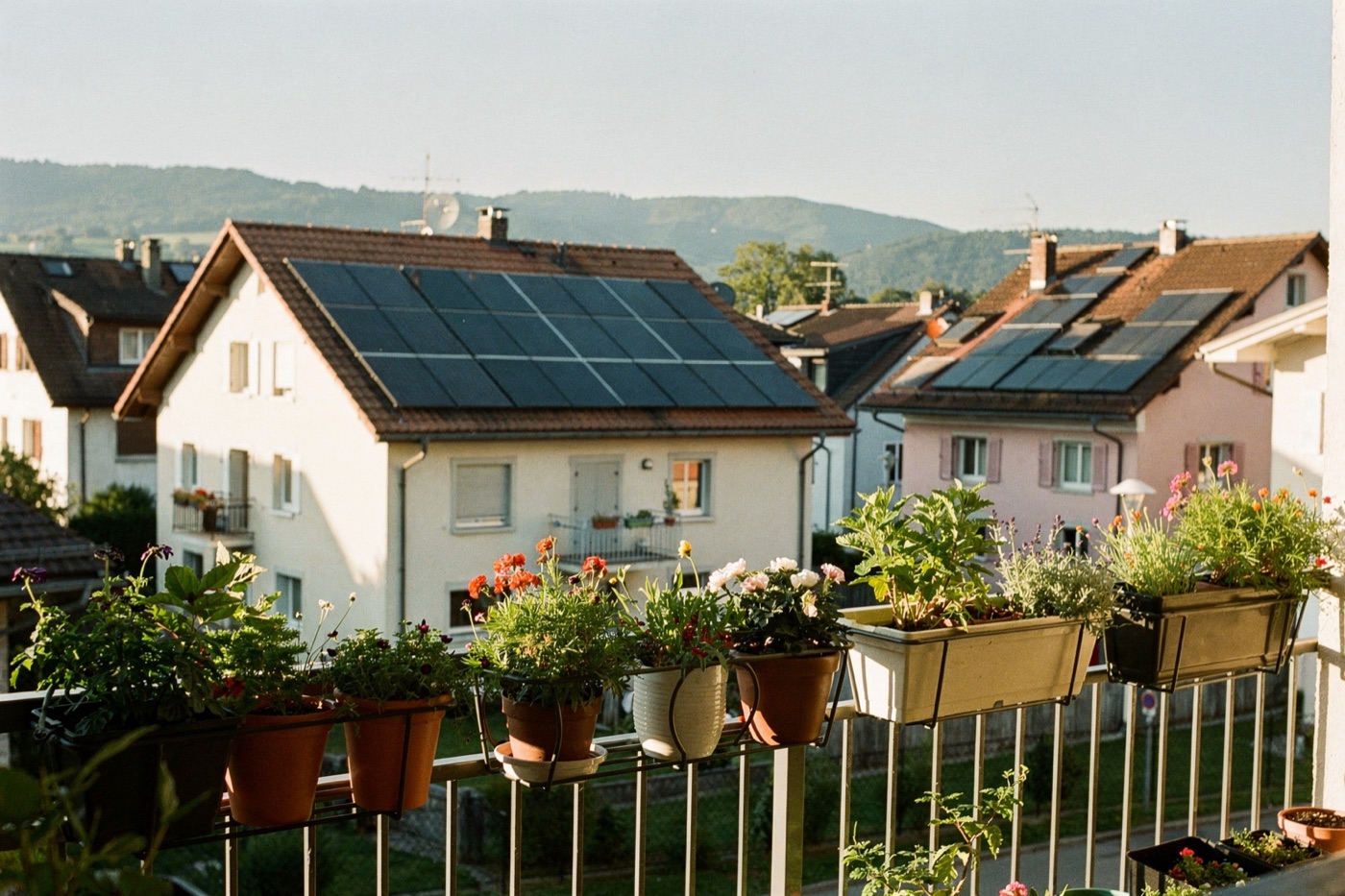
What the bill shows
Two lines instead of one. The solar share, in kWh, at the agreed internal price, often 20 to 30% below the grid tariff. The grid share, in kWh, at your usual tariff, energy, grid usage and levies included. The total kWh does not change, it is your consumption. What changes is the share paid at the low price. In a building of six flats with 25 kWp on the roof, it reaches around 45% of production, and a household of 3’000 kWh generally receives 1’500 to 2’000 kWh of it per year.
In francs, on an example
Household of 3’000 kWh, grid tariff at 27.7 centimes per kWh, the Swiss median for 2026 according to ElCom, internal price at 20 centimes. With 1’900 kWh of solar electricity over the year, the saving is 1’900 × 7.7 centimes, or around 145 francs per year. It is not a revolution, but it is a net gain, without changing any of your habits, and it rises with the size of the installation and with daytime consumption. The detailed calculation, on the owner’s side and on the tenants’ side, is in our article on the RCPv of a six-flat building.
What you can do
- Consume during the day when possible: washing machine, dishwasher, water heater if you have control of it. The roof’s electricity is produced between 9 am and 5 pm, and it is the cheapest.
- Ask for the internal price in writing and check that it respects the 80% cap. A landlord who sets the price at 70% of the grid tariff leaves you a 30% saving on the solar share, that is common practice.
- Keep the annual statement, it will be useful in case of doubt, and it shows how many solar kWh you received.
And if you want to leave
The law provides for only two cases: a tenant who has access to the free market as a large consumer, which does not apply to a flat, or an owner who fails to meet their obligations, deficient supply or non-compliant statement. In practice, a well-run community gives no reason to leave it, since it costs less than the grid by legal construction.
For the owner or the condominium that wants to set up a community, our guide RCPv and CEL in plain language explains both frameworks, and SOLARSPLIT Community Connect takes care of setting it up, notifying the grid operator and preparing the tenants’ statements, contact us to talk about it.
And your roof, what is it worth?
The simulation is free and online, based on your building's public data.
Simulate my project