Guides
Feeding your solar surplus into the grid does not lose you money: the minimum tariff explained
2 September 2026 · SOLARSPLIT
“Will you soon have to pay to supply electricity?”, “Solar is getting less and less attractive for producers”: several headlines this summer suggested that a homeowner who feeds their solar surplus into the grid could end up losing money. For a single-family house, a condominium or an SME whose installation is under 150 kW, that is false. Those articles are missing one sentence of the Energy Act, and that sentence changes everything.
What changed on 1 January 2026
Until 2025, each grid operator set its own feed-in price, often between 10 and 15 centimes per kWh. Since 1 January 2026, the remuneration of injected electricity is based on a reference market price that the Swiss Federal Office of Energy calculates every quarter. It is the average of the day-ahead spot market price, weighted by actual photovoltaic injection. In other words, this price follows what electricity is worth in the hours when solar produces.
The first two quarters showed the range: 10.27 ct/kWh in the first quarter of 2026, then 3.90 ct/kWh in the second, when the spring sun pushed midday prices down. The price is no longer fixed, it swings, and it is this swing that the press described as a bottomless drop.
The minimum tariff, what the law guarantees
The legislator anticipated exactly this case. Article 15, paragraph 1bis of the Energy Act establishes a minimum remuneration for installations with a capacity below 150 kW, and the Energy Ordinance sets how it is calculated:
- Below 30 kW, which covers almost every single-family house: 6 ct/kWh at least, whatever happens on the market.
- From 30 to 150 kW, with own consumption: the floor equals 180 divided by the capacity in kW. A 30 kW installation therefore gets 6 ct, a 60 kW one 3 ct, a 100 kW one 1.8 ct, a 150 kW one 1.2 ct.
- From 30 to 150 kW, without own consumption: a flat floor of 6.2 ct/kWh.
- Above 150 kW: no guaranteed minimum, market conditions apply, generally with a negotiated contract.
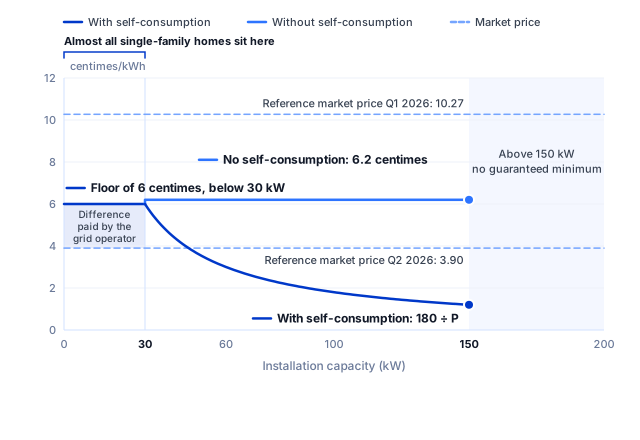
The mechanism is simple: if the quarter’s reference market price falls below the floor, the grid operator pays the difference for every kWh injected. In the second quarter of 2026, the owner of a 10 kWp installation thus received 6 centimes and not 3.9. Depending on the grid operator, a small installation gets either a fixed tariff above the floor, 9.5 centimes including the guarantee of origin at one utility in western Switzerland in 2026, or the quarterly price itself, capped from below by the floor and topped up with the guarantee of origin, 0.5 to 1.5 centimes depending on the quarter.
And in 2027, with the quarter-hourly spot price?
This is where the confusion comes from. In autumn 2025, Parliament decided that from 1 January 2027 the remuneration would no longer be based on the quarterly average but on the spot price at the moment of injection, every quarter of an hour. That price sometimes turns negative, a few hours a year, when the European grid overflows with electricity on a Sunday in May. Hence the headlines: “you could have to pay to inject”.
What those headlines forget is that the minimum remuneration is written into the law and does not disappear in 2027. It applies kWh by kWh: for every kilowatt-hour injected, the grid operator pays the difference between the reference price and the floor, retroactively over the quarter. An hour at a negative price therefore never generates a bill for the owner of an installation below 150 kW, it is simply paid at the floor. The Association of Swiss Electricity Companies and Swissolar have told the press clearly: owners of small installations should not expect to pay.
What the new model really changes is the incentive: inject when electricity is worth a lot, and consume it yourself when it is worth nothing. A battery, a heat pump or a controlled charging station take advantage of that. Those with a real interest in watching negative hours are installations above 150 kW without a contract, and those are managed differently, through agreements with the utility.
What it changes for profitability
The injected kWh has always been the worst paid of your production. The kWh you consume yourself is worth what you no longer pay your supplier, often 25 to 30 centimes. The injected kWh is worth the feed-in price, 4 to 10 centimes depending on the quarter and the utility, never less than the floor. The profitability of an installation therefore depends on the share of self-consumption, not on the feed-in price, and the minimum tariff has no other role than to close the door on the worst-case scenario.
Three levers weigh more than any market variation:
- Size it right, starting from your actual consumption rather than from the available roof area.
- Consume during production hours, with what can already be controlled in your home, hot water tank, heat pump, electric car.
- Sell the surplus locally rather than to the grid, to neighbours, in a self-consumption group or a local electricity community, at a price agreed between you and stable by contract.
Before you believe a headline
A solar installation in Switzerland does not become a burden because the midday market has fallen. The law caps the feed-in price from below for every installation under 150 kW, and yours very probably is one of them. What deserves your attention is your share of self-consumption and the way your surplus is valued. The free online study by SOLARSPLIT estimates your production, your self-consumption and your surplus from your roof and your consumption, before an installer is even mentioned.
And your roof, what is it worth?
The simulation is free and online, based on your building's public data.
Simulate my project