Guides
When a home battery is justified, and how to size it
22 August 2026 · SOLARSPLIT
The home battery has become question number two of any solar project, just after the size of the installation. It deserves better than the two ready-made answers, “essential” and “never pays off”. It is justified in specific cases, which can be described, and it is sized on your consumption, not on the catalogue. Here is the full reasoning.
What it does, exactly
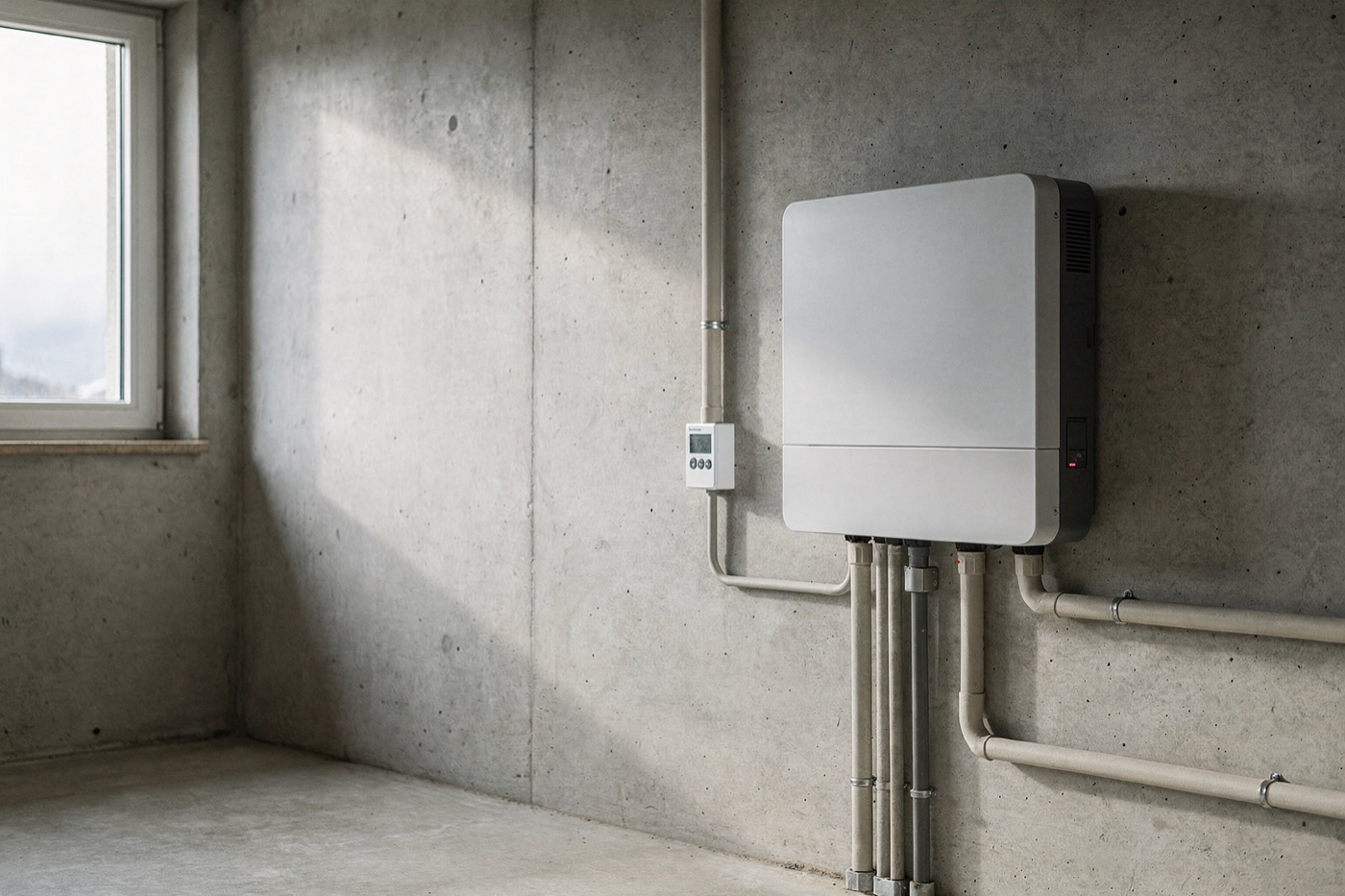
A home battery shifts production from the middle of the day to the evening and the night. It charges when the roof produces more than the house consumes, and discharges when the reverse is true. It does not store summer for winter: in December it rarely fills up, in June it is full by midday. Its effect is measured on a single figure, the share of self-consumption: without a battery, a house consumes 25 to 35% of its production on site, with a well-sized battery 60 to 75%.
What a shifted kWh is worth
Every kWh that the battery saves you from feeding in and then buying back earns you the difference between the grid price and the feed-in tariff: 27.7 centimes, the Swiss median for 2026, less 6 to 10 centimes, or 18 to 21 centimes. A 10 kWh battery that does 250 full cycles a year, which is realistic on the Swiss Plateau, shifts 2’500 kWh and earns in the order of 500 francs per year. It earns more if your evenings consume a lot, and less if the house is empty in the evening.
The cases where it is justified
- Your consumption is in the evening and at night. A family away during the day, with cooking, washing machine and television after 6 pm, feeds in most of its production and buys it back in the evening. That is the profile that gains the most.
- An electric car charged at home. Charging in the evening from the battery rather than from the grid shifts several kWh a day, and a car that can charge at midday at weekends completes the picture.
- A heat pump. It consumes in the evening and at night in winter, when the roof does not produce, but it also consumes in the mid-seasons, where the battery covers a good share.
- A cantonal subsidy. Since March 2026 Neuchâtel has paid a flat 800 francs plus 80 francs per kWh, or 1’600 francs for 10 kWh, which shortens the payback by several years. Our Neuchâtel guide details the conditions, and the other cantons have no equivalent subsidy in 2026.
- The need for backup. With a hybrid inverter designed for it, the battery powers the essential circuits during an outage. That is not a profitability calculation, it is a service, and it counts for some households.
- The dynamic price of 2027. From 2027, the feed-in tariff follows the market by the quarter of an hour. A controlled battery will be able to charge when electricity is worth nothing at midday and let the roof feed in when it is worth a lot at the end of the day. The gain will depend on the price spreads, but the direction is clear: the battery becomes a control tool, not just a storage one.
The cases where it can wait
- A house that consumes mainly during the day, with someone at home, a hot water tank controlled at midday and a washing machine on a timer: self-consumption is already good, the battery adds little.
- An installation that is small relative to consumption, which feeds in little anyway.
- A tight budget: better a slightly larger roof today, and a battery in a few years, when the car or the heat pump arrives. It is enough to choose a hybrid inverter now, ready to receive it.
The right size
Two benchmarks that overlap: around 1 kWh of battery per kWp of panels, and the consumption of an evening and a night, or 5 to 10 kWh for a single-family house, more with a car. A battery that is too big does not fill up in the mid-seasons and costs for nothing, a battery that is too small is full by 2 pm and lets the rest go to the grid. SOLARSPLIT’s online study simulates your self-consumption with and without a battery, from your consumption, and shows the effect of each capacity.
The price, the subsidies, the lifespan
Allow in the order of 800 to 1’200 francs per kWh installed, or 8’000 to 12’000 francs for 10 kWh, hybrid inverter included or not depending on the case, to be checked on the quote. The federal one-off remuneration does not cover the battery, the tax deduction covers it when it is installed with the installation on an existing building. A lithium iron phosphate battery withstands 6’000 cycles and more, which at 250 cycles a year exceeds twenty years, with a ten-year warranty from most manufacturers.
On the example of 10 kWh at 9’000 francs with the Neuchâtel subsidy, the payback is in the order of fifteen years on electricity savings alone, less with an electric car, less still if the 2027 prices open up arbitrage. That is longer than the installation itself, and that is normal: the battery is judged on what it brings to the whole project, autonomy, comfort, control, not only on its own francs.
To place the battery in the full budget, our article on the cost of an installation, and to understand why it has nothing to do with winter, solar produces in winter too.
And your roof, what is it worth?
The simulation is free and online, based on your building's public data.
Simulate my project