Guides
'Solar produces nothing in winter': what the figures say
26 August 2026 · SOLARSPLIT
It is the objection that comes back from November onwards: “in winter, the panels are useless”. It is false, and the way it is false matters, because the winter kWh is precisely the one that brings in the most. Here is what a Swiss roof produces between October and March, and why it has to be counted differently.
Less, not nothing
On the Swiss Plateau and in French-speaking Switzerland, a well-oriented 10 kWp installation produces around 10’000 kWh per year. The distribution is not uniform: June and July each account for 12 to 14% of the year, December and January 3 to 4% each. Over the six months from October to March, you harvest between a quarter and a third of annual production, or 2’500 to 3’300 kWh for this installation. Swissolar’s monthly statistics for the whole Swiss fleet give the same order of magnitude: a little over a quarter of national production arrives in the winter half-year.
It is not summer production, but it is not zero. A 10 kWp installation delivers in December the equivalent of one June day per week, and from February the curve climbs quickly, March already produces as much as September.
Cold helps, and so does snow
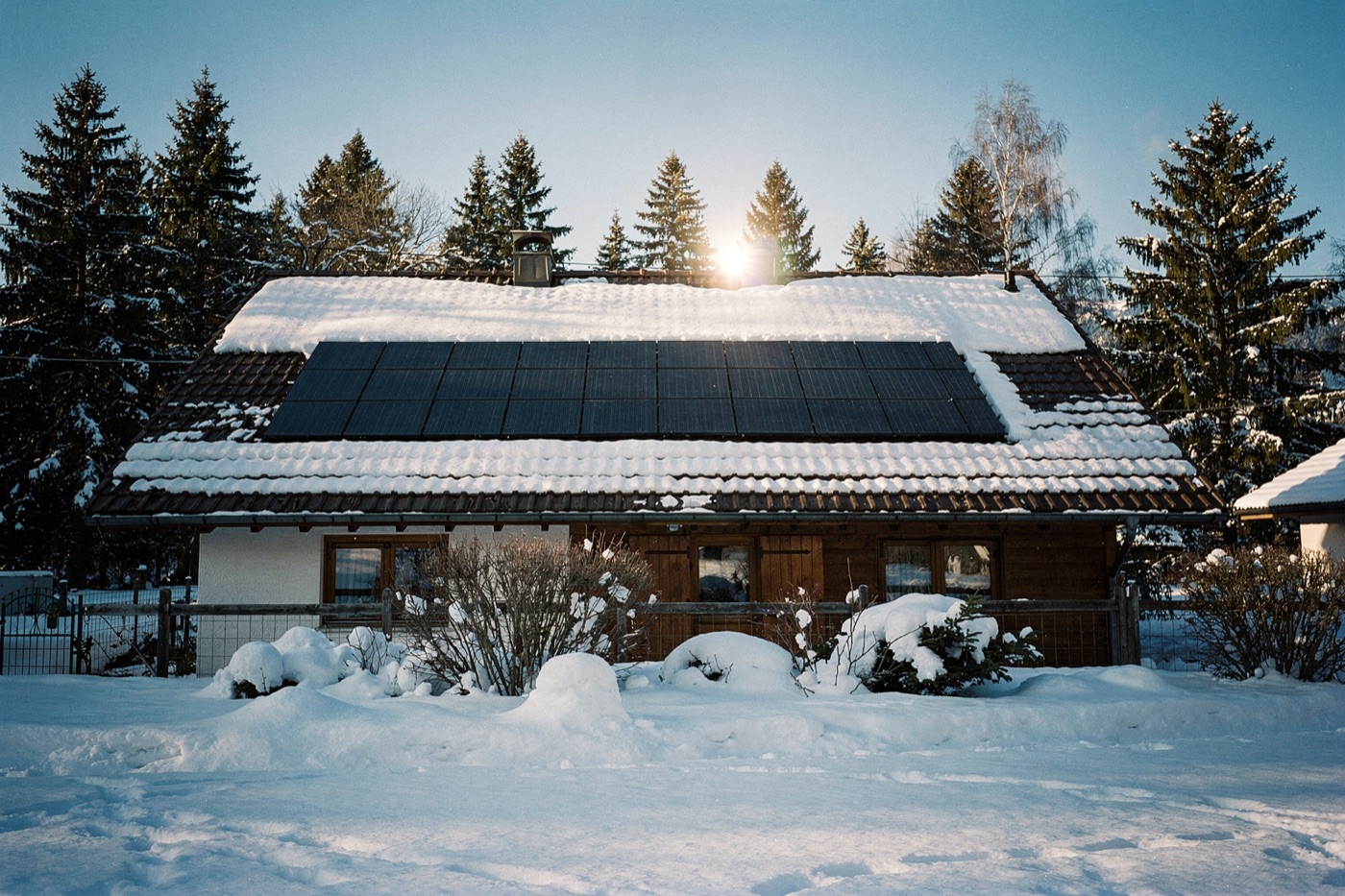
A photovoltaic panel loses efficiency as it heats up, in the order of 0.3 to 0.4% per degree above 25 °C. On a clear January day at 0 °C, it therefore works at a better efficiency than in a heatwave. Winter’s real enemy is not the cold, it is the stratus fog layer, the sea of fog that covers the Swiss Plateau for weeks on end. Above 1’000 metres, the same month of December is often sunny, and the snow on the ground reflects the light towards the panels.
That is why the Confederation pays an altitude bonus above 1’500 metres and a tilt bonus from 75 degrees: a steep panel, on a facade or on a chalet roof, lets the snow slide off and catches the low sun. On an ordinary roof at 30 degrees, a layer of snow slides off within a day or two of sunshine, and the annual loss due to snow is counted in days of production, not weeks.
Why the winter kWh is worth three to five times more
This is the point the objection misses. In summer, a house produces far more than it consumes in the middle of the day, and the surplus goes to the grid at the feed-in price, between 4 and 10 centimes depending on the quarter, never less than the legal floor of 6 centimes under 30 kW. In winter, the house consumes more, heating and heat pump first, and almost everything the roof produces is consumed on site. That kWh saves you buying electricity at 25 to 30 centimes, the Swiss average price in 2026 being 27.7 centimes according to ElCom.
In other words, 3’000 winter kWh consumed on site are worth around 800 francs on the bill, while 3’000 kWh of summer surplus injected bring in 150 to 250. Winter production is lower in kWh, but it weighs heavily in francs, and it accounts for a good part of the real profitability of an installation sized for the house.
What it changes for sizing
- A heat pump turns winter into a self-consumption season. Solar and the heat pump are calculated together, and a slightly larger roof is often justified.
- An east-west roof or a south-facing facade produce more evenly over the day and over the year than a steep 45-degree south pitch. Our guide on roof orientation gives the differences.
- The battery does not store summer for winter, it shifts midday production to the evening of the same day. In winter it rarely fills up, in summer it avoids selling the surplus off cheaply. It is sized on your profile, not on the season.
- In the mountains, the calculation reverses: a chalet above the stratus fog layer can produce more in February than in July per kWp, and our Valais guide explains the altitude bonus.
And for the country
Switzerland imports electricity in winter and exports it in summer. Every winter solar kWh consumed on site reduces imports by that much at the moment they cost the most, and that is precisely what the 2025 Electricity Act is after with its alpine installations. A house roof is not an alpine power plant, but put end to end, roofs already provide the bulk of Swiss solar production, winter included.
SOLARSPLIT’s free online study calculates your roof’s production month by month, from the weather data for your address, and your self-consumption from your consumption, heating included. That is where you see what your winter is really worth.
And your roof, what is it worth?
The simulation is free and online, based on your building's public data.
Simulate my project