Guides
Is my roof suitable for solar? Orientation, pitch, shade and area
9 May 2026 · SOLARSPLIT
“My roof does not face south, it is not worth it.” It is the most frequent objection, and it dates from a time when panels cost three times as much. Today, the majority of roofs in Switzerland are suitable, and the useful question is no longer “is it possible” but “how much will my roof produce, and with what area”. Here is what counts, and in what order.
Orientation: south is no longer compulsory
Swissolar puts it simply: any unshaded roof whose orientation deviates by no more than 45 degrees from south is particularly well suited. South-east and south-west produce almost as much as due south. And an east-west roof, long dismissed, generally produces 80 to 85% of a south-facing roof for the same area, with an advantage south does not have: production is spread from morning to evening, which matches a house’s consumption better and pushes self-consumption up. That is why the industry fits panels on both pitches more and more often.
North remains the unfavourable case. A steep north pitch produces half as much as a south pitch, it is only fitted if space is lacking elsewhere.
Tilt: 30 degrees, but the gap is small
At our latitudes, the maximum annual irradiation is obtained at around 30 degrees facing south. Between 20 and 45 degrees, the difference over the year stays within a few percent. A flat roof is not an obstacle: the panels are placed on ballasted mounts there, often east-west to fit more area. A steep pitch, beyond 60 degrees, loses in summer but gains in winter, when the sun is low and the snow slides off. That is the case of facades and high-altitude chalets, which the Confederation rewards with a bonus.
Shade: the real enemy
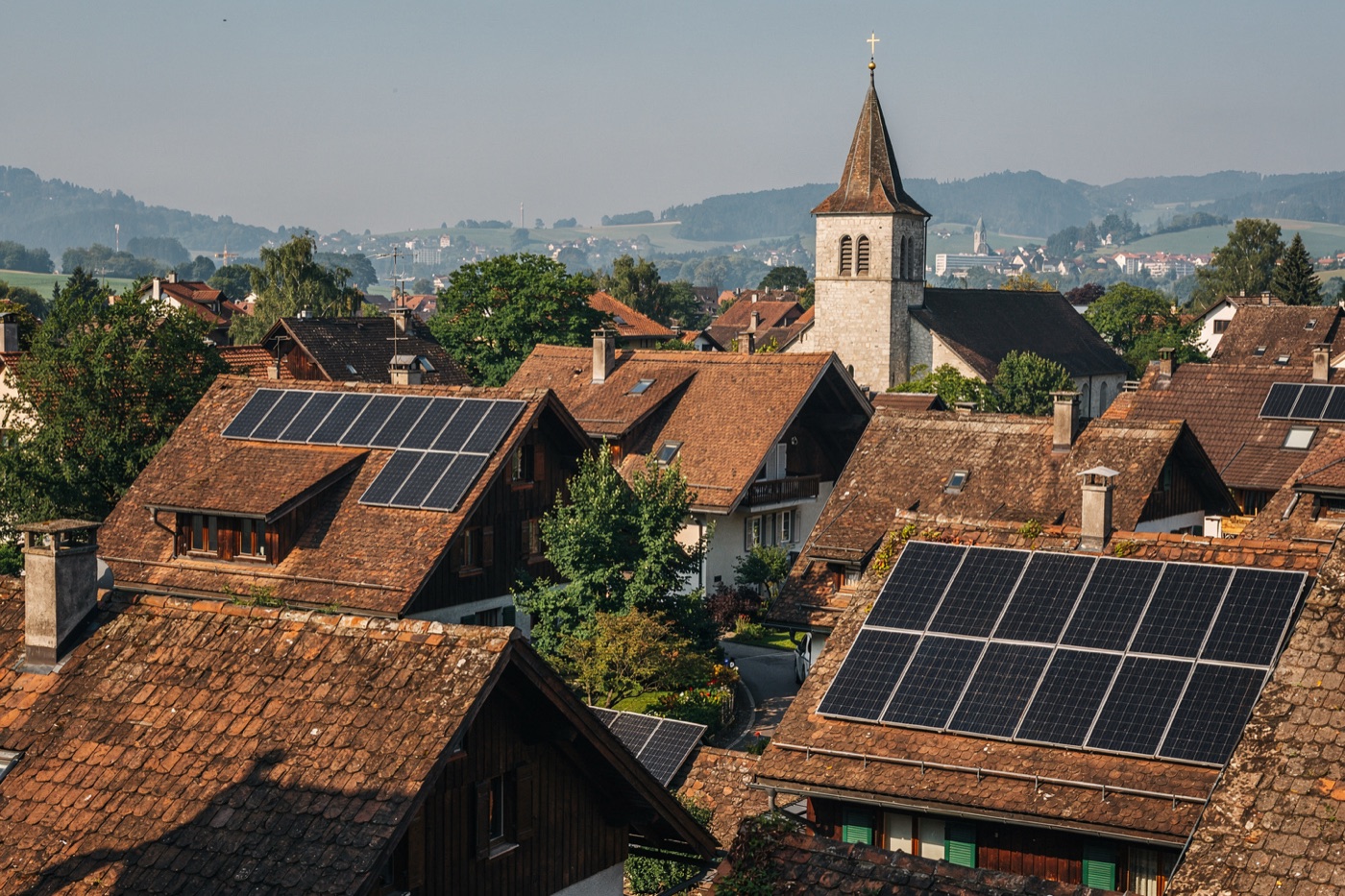
A chimney, a tree, a neighbouring building or a dormer weigh more than a poor orientation. Shade cast on part of a panel can bring down the whole string of panels connected to it, unless the installation includes optimisers or micro-inverters. The right reflex is to look at your roof in winter, at midday, when the sun is at its lowest: whatever is in the shade at that moment will be for a good part of the year.
Area: five square metres per kWp
One kWp takes up about 5 m² of modern panels. A 10 kWp installation, the typical size for a single-family house, therefore needs some fifty square metres in one piece, excluding chimneys, roof windows and safety margins at the edges. A 30 m² pitch takes 6 kWp, which already covers a good share of a household’s consumption. The available area is counted on the actual roof, not on the ground footprint.
How the Confederation has already rated your roof
Every roof in Switzerland has been analysed by the Swiss Federal Office of Energy from MeteoSwiss weather data, the 3D building model and the terrain for shadows. The sonnendach.ch site rates each pitch on five levels, from “low” to “excellent”, and indicates the electricity it could produce per year. It is a reliable starting point for orientation and tilt. What it does not see: the neighbour’s tree planted since, the condition of the covering, and your consumption, which decides the useful size.
What the online study adds
SOLARSPLIT’s free online study starts from your address, splits your roof pitch by pitch on the federal aerial images, keeps the usable areas, lays the panels on them and calculates the expected production, the one-off remuneration and your self-consumption from your consumption. In two minutes you know whether your roof is worth it, and by how much. The technical visit then checks on site the condition of the roof, the actual shading and the cable routing, before installers put a figure on it.
And your roof, what is it worth?
The simulation is free and online, based on your building's public data.
Simulate my project