Guides
Selling your surplus to the neighbours rather than to the grid: from what gap is it worth it
6 July 2026 · SOLARSPLIT
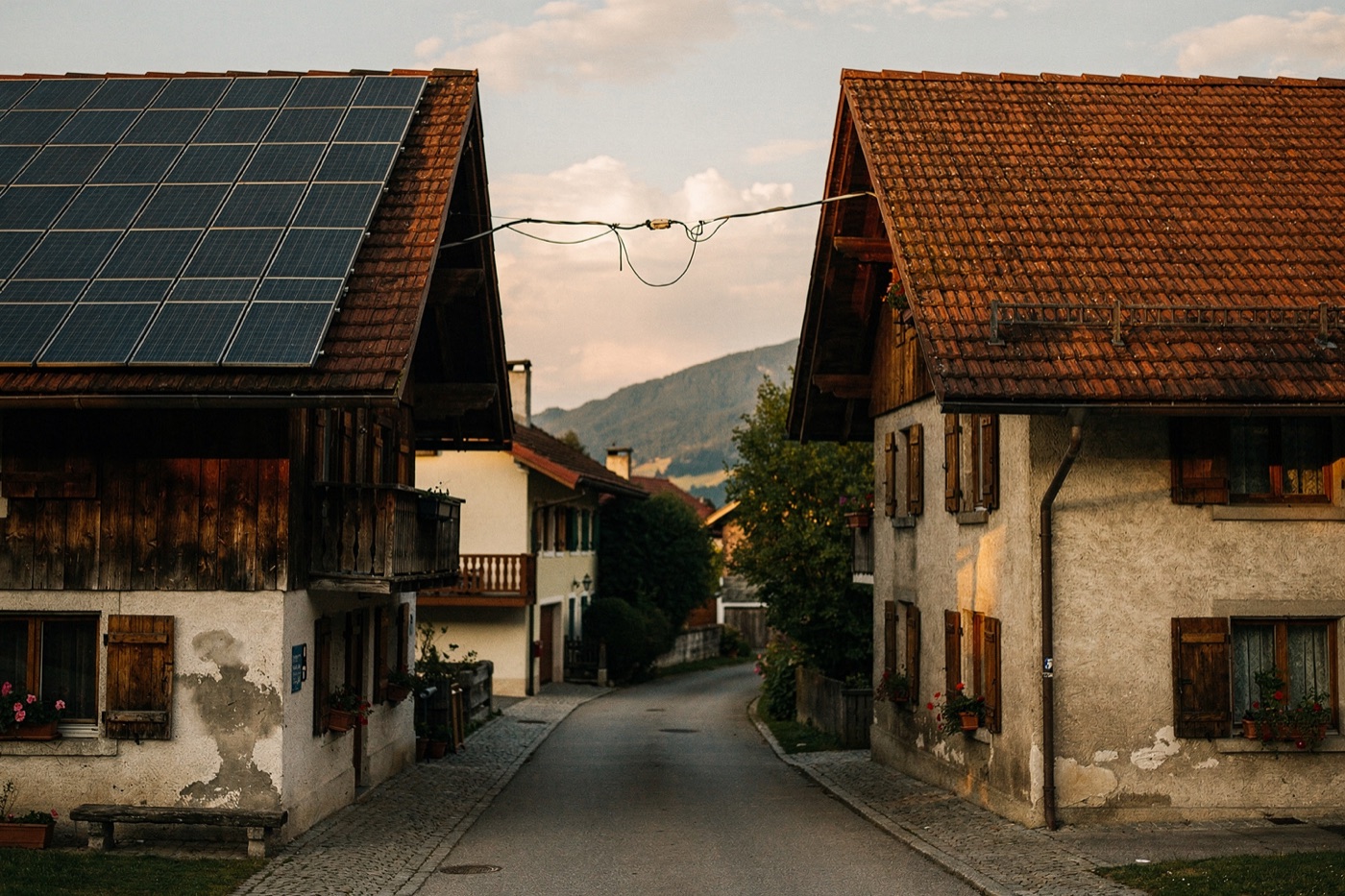
A 10 kWp roof feeds 5’000 to 6’000 kWh a year into the grid, paid at the feed-in tariff, between 4 and 10 centimes depending on the quarter, never less than the 6-centime floor. The neighbour across the street buys theirs from their supplier at 27 centimes, the Swiss median for 2026. Twenty centimes of gap, part of which the law now allows you to share: that is the local electricity community (CEL), in force since 1 January 2026. Here is where the value comes from, exactly, and from what point it justifies the effort.
Where the gap comes from, line by line
The tariff your neighbour pays breaks down into three parts: energy, around 12 centimes in 2026, grid usage, between 8 and 12.5 centimes depending on the operator, and taxes and levies, around 3 centimes. When they buy your surplus in a local electricity community, they pay the energy to you, at the price agreed between you, and they keep paying the grid and the levies to their operator, but with a 40% discount on the grid usage component, because the electricity has only travelled a few dozen metres of low-voltage line.
The value created per shared kWh is then simple to calculate: the energy the neighbour no longer buys from their supplier, minus the feed-in tariff you no longer receive, plus the grid discount. With 2026 figures:
- With an operator whose grid share is 12.5 centimes, the discount is 5 centimes, and the value of a shared kWh is 12 − 7 + 5 = around 10 centimes.
- With an operator whose grid share is 7.8 centimes, the discount is 3.1 centimes, and the value drops to around 8 centimes.
The discount therefore depends on the grid operator, and it varies by a factor of two from one municipality to the next. It is the first thing to check, on the tariff breakdown published by ElCom for your distributor.
Who keeps the value: the internal price decides
The price of electricity exchanged in a community is free, the law sets no cap. It is what splits the 8 to 10 centimes between the producer and the buyer. An example, with the operator offering the 5-centime discount: you sell at 12 centimes, 5 more than the feed-in tariff, and your neighbour pays 12 of energy plus 7.5 of grid plus 3 of levies, 22.5 centimes instead of 27.7, 5 less. Each of you gains 5 centimes per kWh. Sell at 14 and the balance tips towards you, at 10 towards them.
On 3’000 kWh shared per year, that is 250 to 300 francs of value to split, every year, for the life of the installation.
From what gap is it worth it
The community has a running cost: someone has to set it up, declare it, keep the agreement, receive the load curves from the operator and issue invoices. Allow an order of magnitude of 2 centimes per shared kWh plus a fixed share per participant per year for a provider that takes care of it. The rule that follows:
- The value per kWh must clearly exceed the costs, which is the case wherever the grid discount reaches 3 centimes or more, so with every operator in French-speaking Switzerland.
- The shared volume must be large enough to absorb the fixed share. Two villas exchanging 1’500 kWh gain little. A villa supplying three neighbours, or a building selling its surplus to the house next door, gain clearly.
- Simultaneity matters. Only electricity produced and consumed within the same quarter of an hour is shared. A neighbour away during the day buys almost nothing, a practice, a workshop or a family with a heat pump buy a lot.
The conditions to meet
- The capacity of the installations must reach at least 5% of the connection capacity of all the consumers in the community.
- All participants are in the same service area, connected at low voltage, and the electricity must be able to flow from each installation to each consumer without passing through a transformer. Otherwise, the discount drops to 20% for everyone, not just for the distant participant. That is the number one design trap.
- A written agreement between participants, with a representative, the internal prices, the split of costs, the rules for joining and leaving.
- Three months’ notice to the grid operator to set up the community, one month for each joining or leaving afterwards.
- The guarantees of origin for the production must follow the shared electricity, which Pronovo checks.
And in an apartment building?
Inside a building, the self-consumption community (RCPv) remains more advantageous than the local electricity community: it avoids the grid share entirely on the shared electricity, not just 40%. Our calculation on a six-flat building shows it. The local electricity community takes over for what leaves the building, and the two combine: the building in an RCPv sells its surplus to the neighbour in a CEL. The guide on the neighbourhood electricity community gives a multi-building case.
SOLARSPLIT Community Connect checks the perimeter, calculates the value with your operator’s tariffs, sets up the community and manages the statements, contact us with your address and those of the interested neighbours.
And your roof, what is it worth?
The simulation is free and online, based on your building's public data.
Simulate my project