Guides
The grid operator's role in a self-consumption community: deadlines, power of attorney, meters
25 June 2026 · SOLARSPLIT
When an apartment building or a neighbourhood decides to share its solar electricity, the grid operator, Viteos, Groupe E, Romande Energie, SIG, SIL or ESR depending on the municipality, becomes an unavoidable player. It measures, it registers, it applies the discounts, and it has deadlines set by law. Here is exactly what it does, in what order, and what you can expect from it.
What it has to do, and by when
- Provide the topology. To know which buildings can group together, you need to know each one’s connection point and grid node. The operator must provide this information within fifteen working days, for a self-consumption community (RCPv) as for a local electricity community (CEL). The Energy Ordinance and the Electricity Supply Ordinance say so.
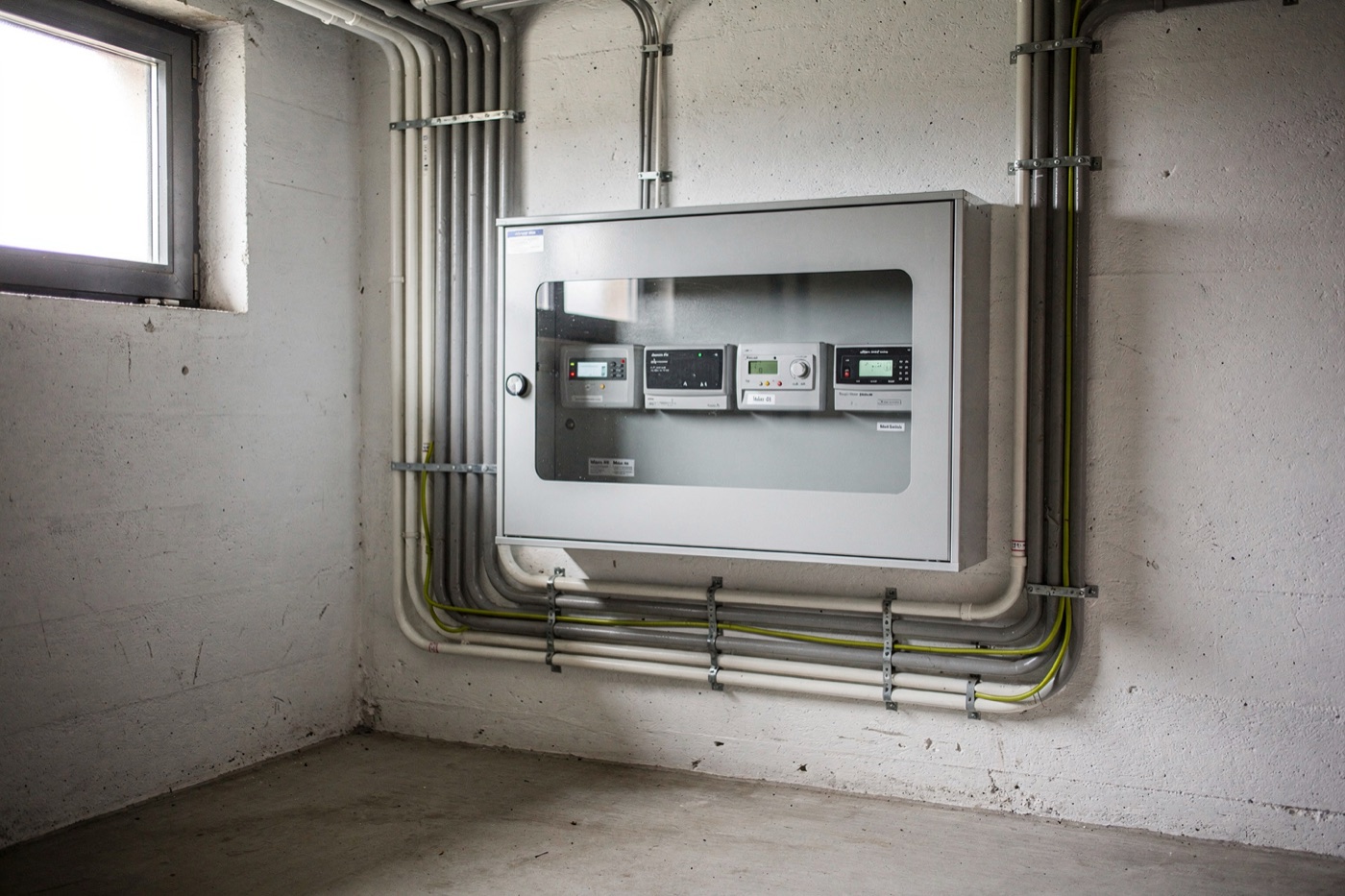
- Install the smart meters. Quarter-hourly measurement of each participant relies on the operator’s smart meter, whose roll-out is a legal obligation at its expense, 80% of metering points by the end of 2027. No private equipment to install in a virtual community, that is the whole point of the formula.
- Register the community. Setting it up is declared at least three months in advance, for the end of a month, dissolution included. An operator that announces a three-month lead time is applying the rule, it is not slowness. Participants joining or leaving a local electricity community are declared one month in advance.
- Virtually sum the flows. In a self-consumption community, the operator adds up the purchases and sales of all participants as if they were behind a single meter. That is what makes the grid share disappear on electricity shared within the community.
- Transmit the load curves. By quarter of an hour, per participant, on its portal or through standardised data exchange, so that the community’s representative can prepare the statements.
- In a local electricity community, calculate the shares and apply the discount. The law entrusts it with the calculation: the smaller of the two quantities between the community’s injection and its withdrawal, by quarter of an hour, is split between participants in proportion to their consumption, and the 40% discount on grid usage lands directly on each one’s bill.
What it does not do
The operator does not set the internal price of the shared electricity, does not invoice participants among themselves, does not draft the agreement and does not choose the allocation keys of a community. All of that is up to the participants, or to the provider they appoint. Some operators offer their own statement service, for a fee, with the keys their system supports: that is a competing offer, not a compulsory step.
Nor does it decide who is a producer: it is the installation’s connection point, chosen with the installer, that determines whether the production has its own metering point or goes through the common areas meter. Above 30 kVA, dedicated production metering becomes a de facto requirement, because guarantees of origin become mandatory and require certified measurement.
The power of attorney, the provider’s key
A community has a representative. When it entrusts management to a provider, it gives it a power of attorney that authorises it to declare the community to the operator, to receive the metering data and to correspond on its behalf. It is a one-page document, signed by the owner or the condominium, and it is what allows SOLARSPLIT Community Connect to file the feasibility and registration forms, follow up the operator’s reply and retrieve the load curves without the owner having to deal with it.
The realistic calendar
- Topology request: reply within fifteen working days.
- Drawing up the list of participants, agreement, signatures: two to six weeks depending on the number of people.
- Declaration to the operator: three months before the end of the target month.
- Check by the operator that the smart meters are in place, installation of any missing ones if necessary.
- Confirmation, then first load curves and first statement the following month.
Allow four to five months between the decision and the first statement, and longer if meters have to be installed outside the roll-out schedule, which some operators charge for.
The pitfalls encountered
- The capacity threshold. The law requires production to reach at least 10% of the community’s connection capacity. An operator’s form that talks about “consumption capacity” is more permissive than the law, do not size on it.
- The transformer. In a local electricity community, if a single participant can only be reached through a voltage transformation, the discount drops from 40 to 20% for everyone. Check the topology before inviting the neighbour at the end of the street.
- The CEL, behind schedule at some operators. The framework has been in force since January 2026, but not all operators have their calculation tool ready yet. The RCPv, for its part, has been running everywhere since 2018.
- The tenant. They have three months to choose between the community and their basic supplier, and their metering point only joins the community with the agreement of the property owner. Our article for tenants explains what they receive.
For an overview of the two frameworks, our guide RCPv and CEL, and for a worked example, the six-flat building. SOLARSPLIT Community Connect handles the relationship with the grid operator from end to end, contact us.
And your roof, what is it worth?
The simulation is free and online, based on your building's public data.
Simulate my project