Guides
RCPv or CEL on a six-flat building: the concrete calculation
2 July 2026 · SOLARSPLIT
A building owner who installs panels quickly faces a question the villa does not raise: who consumes the electricity from the roof? Without doing anything, only the common areas, stairwell, lift, laundry room, benefit from it, and the rest goes to the grid at the feed-in price. With a self-consumption community, the tenants consume the roof’s electricity and pay the owner for it. Here is the full calculation, on a typical case and with stated assumptions.
The typical case
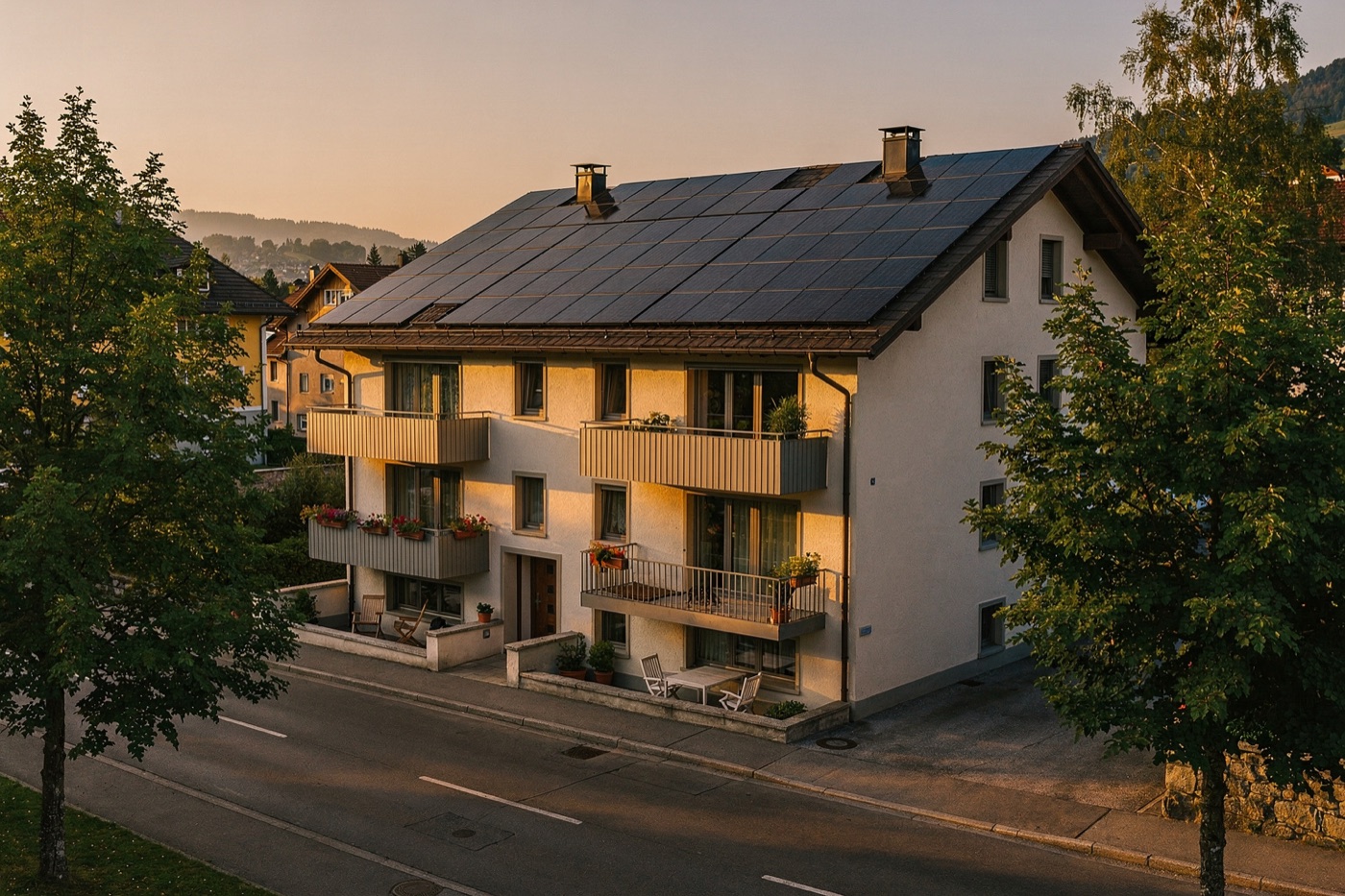
- A building of six flats in French-speaking Switzerland, with a roof that takes 25 kWp.
- Expected production: 25’000 kWh per year, at 1’000 kWh per kWp, an ordinary value on the Swiss Plateau.
- Consumption: six households at 3’000 kWh, or 18’000 kWh, plus 2’000 kWh of common areas, 20’000 kWh in total.
- Local supplier’s tariff: 27.7 centimes per kWh, the Swiss median for 2026 according to ElCom for a typical household, all components included.
- Feed-in price for the surplus: 7 centimes on average over the year, between the legal floor of 6 centimes and the better-paid winter quarters.
- Investment: 37’500 francs gross, at 1’500 francs per kWp for an installation of this size, less 9’000 francs of one-off remuneration, 28’500 francs net.
Without a community: the roof only serves the common areas
The common areas meter is the only one connected to the installation. It absorbs around 2’000 kWh per year, the rest, 23’000 kWh, is injected.
- Electricity avoided on the common areas: 2’000 kWh × 27.7 ct = 554 francs
- Surplus sold: 23’000 kWh × 7 ct = 1’610 francs
- Total: around 2’160 francs per year, a return on the net investment in thirteen years.
This is the situation of many buildings equipped before 2018, and it explains why so many apartment building roofs remain bare: without sharing, the installation pays for itself slowly.
With an RCPv: the tenants consume the roof
The self-consumption community, RCPv (ZEV), gathers all the flats behind a single meter facing the grid. Inside, private sub-meters measure what each one consumes. The roof’s electricity that goes from one flat to another does not pass through the public grid, so pays neither the grid usage fee nor the levies that come with it, and that is where the margin to be shared lies.
With six households on different schedules, the share of production consumed on site rises to around 45%, against 10% with the common areas alone. The owner sets an internal price, capped by law: they cannot charge the solar electricity more than the tenant would pay their supplier. In our case, 20 centimes per kWh, 28% less than the grid tariff.
- Electricity consumed on site: 45% of 25’000 kWh = 11’250 kWh
- Sold to the tenants and the common areas: 11’250 kWh × 20 ct = 2’250 francs
- Surplus injected: 13’750 kWh × 7 ct = 963 francs
- Owner’s total: around 3’210 francs per year, 1’050 francs more than before.
- On the tenants’ side: 11’250 kWh paid at 20 instead of 27.7 centimes, 866 francs saved in the building, around 145 francs per household per year.
The community costs the sub-meters, a few hundred francs per flat, and annual management of the statements. Even adding 3’000 francs of equipment, the payback drops to ten years instead of thirteen, and the tenants pay less than before. The only one that loses is the grid share not charged on the kWh that stayed in the building, which is exactly the intention of the law.
What makes the RCPv possible
- The installation must reach at least 10% of the connection capacity of the community, which is the case for 25 kWp on six flats.
- The flats must be contiguous, on the same plot or neighbouring plots without the public grid in between. A single building meets the condition automatically.
- The tenants must be informed and the internal price must respect the legal cap. A tenant cannot be charged more than the supplier would cost them.
- The grid operator is notified, it removes the individual meters and leaves only one.
And the CEL, in this case?
The local electricity community, CEL (LEC), is the framework that came into force in 2026 for sharing electricity through the public grid, between neighbours in the same municipality. It does not replace the RCPv within a building: inside the building, the community remains simpler and more profitable, because it avoids the grid usage fee entirely. The CEL becomes interesting when the building’s surplus can go to the neighbour across the street, or when a condominium wants to bring in a second address: the electricity exchanged then benefits from a 40% discount on the grid usage tariff at low voltage level, or 3 to 5 centimes per kWh depending on the grid operator. The two frameworks combine, the building in an RCPv sells its surplus to the CEL rather than to the grid. Our guide to RCPv and CEL details both, and the one on the neighbourhood CEL gives a multi-building case.
The three figures that decide
- The share consumed on site. The more numerous and diverse the households, the higher it climbs. Six flats give 40 to 50%, a condominium of twenty flats often exceeds 60%.
- The internal price. Low enough for the tenants to gain, high enough for the roof to pay for itself. Between 20 and 30% below the grid tariff, everyone comes out ahead.
- The size of the installation. A roof that produces twice what the building consumes sells half at the feed-in price. The right sizing is the one that matches the building’s annual consumption, with the option of expanding later if a heat pump or charging stations arrive.
How to go about it
For the roof, SOLARSPLIT’s free online study sizes the installation on the building’s actual surfaces and on its consumption, then puts installers in competition. For the sharing, SOLARSPLIT Community Connect takes care of setting up the community, the sub-meters, the tenants’ statements and the connection to a CEL where one exists, as described in our article on RCPv in an apartment building. The calculation above can be redone with your figures in a few minutes, contact us to do it together.
And your roof, what is it worth?
The simulation is free and online, based on your building's public data.
Simulate my project