Guides
Should you redo the roof before installing panels? And the asbestos question
3 June 2026 · SOLARSPLIT
It is the objection that stalls entire projects: “my roof is thirty years old, if I put panels on it, everything will have to come off the day I redo it”. It is well founded, and the answer is neither “redo everything” nor “it will be fine”. It depends on the real age of the roof covering, on its material, and on a question of timing that is better asked before the quote than after.
Thirty years of panels on a covering that has to last as long
Modern panels still deliver 85 to 90% of their initial output after twenty-five years, and an installation commonly lives thirty years. The covering that carries them therefore has to last at least as long without major work. If it fails halfway through, the panels have to be removed, stored, the roof redone, then the panels put back: several thousand francs of labour, a halt in production, and sometimes panels of a model that is no longer made.
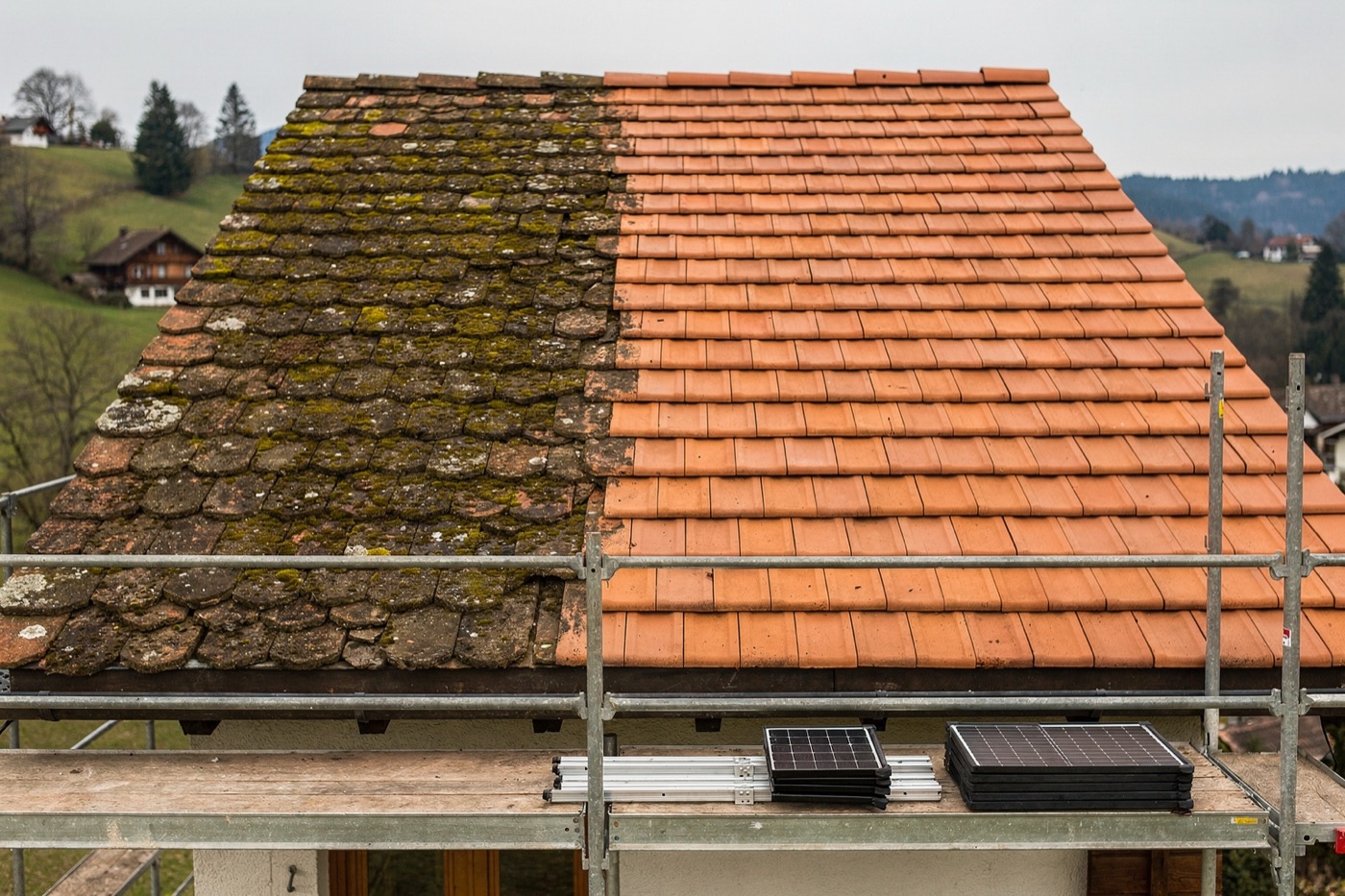
The common-sense rule: a covering with fewer than fifteen years of life ahead of it gets redone first. A well-laid clay tile roof lasts fifty years and more, a concrete tile covering forty, a flat roof with bituminous waterproofing twenty to thirty. The figure that counts is not the age, it is the condition: frost-damaged tiles that crumble, tired battens, missing or torn underlay, thick moss, known leaks. A roofer sees it in ten minutes, and that is precisely what SOLARSPLIT’s technical visit checks before the installers put a price on it.
When renovating first is a good deal
If the roof has to be redone within ten years anyway, doing it at the same time as the solar installation costs less than the two jobs done separately: one scaffolding, one roofer, one coordination. It is also the moment to choose an integrated installation, where the panels replace the roof covering instead of sitting on top of it. It costs more per square metre, but it saves the tiles under the panels, receives a higher federal bonus in the one-off remuneration, and is often the only option on a listed building.
And the cost of the renovation itself is deducted from taxable income as maintenance costs, just like the installation, which softens the bill in the year of the works.
When you can wait
A sound covering, even an old one, does not get redone “for peace of mind”. Thirty-year-old tiles in good condition, dry battens, underlay in place: the roofer can confirm it, and the panels are mounted with suitable hooks that weaken nothing. What is worth doing in that case is having the few cracked tiles replaced and checking the tricky points, chimney, ridge, valleys, before mounting, because they become inaccessible afterwards.
On a flat roof, the question is the waterproofing: if it is more than twenty years old or shows blisters, redo it first, because panels on ballasted mounts cover the whole surface and make a spot repair very expensive.
Asbestos, the question that changes everything
Corrugated sheets and slates in fibre cement laid before 1991 contain asbestos, prohibited in Switzerland since 1990 and banned from building materials the following year. There is still plenty of it on the roofs of barns, outbuildings and workshops, and on some houses from the 1960s to the 1980s.
On such a covering, installing panels is not an option. Drilling or sawing an asbestos sheet releases large quantities of fine, carcinogenic fibres, Suva requires full protective measures for any work on it and recommends that the owner have the roof replaced. Corrugated sheets also cannot bear a person’s weight without breaking. A serious installer turns the job down, and rightly so.
The procedure: have the presence of asbestos confirmed by a survey, then entrust the asbestos removal to a recognised firm, with disposal of the sheets through a controlled channel. The new covering then receives the panels in good conditions, often as an integrated installation. Asbestos removal has a real cost, but it ends up being unavoidable anyway, and solar gives it a reason to happen now rather than in ten years. Some cantons support renovation of the building envelope through the Buildings Programme, our cantonal guides (Neuchâtel, Vaud, Fribourg) say which ones.
What the technical visit looks at
Before the call for tenders, the technical office appointed by SOLARSPLIT goes up on the roof. It records the condition of the covering and the roof structure, spots the tiles to be replaced, checks for fibre cement or other suspect materials, and measures the cable route to the electrical panel. The report goes to the installers with the file, which avoids the quote “subject to the condition of the roof” that you discover on installation day. And if a renovation is required, it is priced at the same time, in the same file.
The free online study starts with your address and your roof, the technical visit then comes to confirm on site. And to find out whether a quote does include preparation of the roof covering, our guide to reading a solar quote lists the lines to look for.
And your roof, what is it worth?
The simulation is free and online, based on your building's public data.
Simulate my project